Chandrasekhar number

The Chandrasekhar number is a dimensionless quantity used in magnetic convection to represent ratio of the Lorentz force to the viscosity. It is named after the Indian astrophysicist Subrahmanyan Chandrasekhar.

The number's main function is as a measure of the magnetic field, being proportional to the square of a characteristic magnetic field in a system.

DefinitionEdit

The Chandrasekhar number is usually denoted by the letter \ Q, and is motivated by a dimensionless form of the Navier-Stokes equation in the presence of a magnetic force in the equations of magnetohydrodynamics:

{\displaystyle {\frac {1}{\sigma }}\left({\frac {\partial ^{}\mathbf {u} }{\partial t^{}}}\ +\ (\mathbf {u} \cdot \nabla )\mathbf {u} \right)\ =\ -{\mathbf {\nabla } }p\ +\ \nabla ^{2}\mathbf {u} \ +{\frac {\sigma }{\zeta }}{Q}\ ({\mathbf {\nabla } }\wedge \mathbf {B} )\wedge \mathbf {B} ,}

where \ \sigma is the Prandtl number, and \ \zeta is the magnetic Prandtl number.

The Chandrasekhar number is thus defined as:[1]
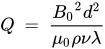
{\displaystyle {Q}\ =\ {\frac {{B_{0}}^{2}d^{2}}{\mu _{0}\rho \nu \lambda }}}

where {\displaystyle \ \mu _{0}} is the magnetic permeability\ \rho  is the density of the fluid, \ \nu  is the kinematic viscosity, and \ \lambda  is the magnetic diffusivity{\displaystyle \ B_{0}} and \ d are a characteristic magnetic field and a length scale of the system respectively.

It is related to the Hartmann number{\displaystyle \ H}, by the relation:

{\displaystyle Q\ {=}\ H^{2}\ }


This article uses material from the Wikipedia article
 Metasyntactic variable, which is released under the 
Creative Commons
Attribution-ShareAlike 3.0 Unported License
.
