Chandrasekhar potential energy tensor

In astrophysicsChandrasekhar potential energy tensor provides the gravitational potential of a body due to its own gravity created by the distribution of matter across the body, named after the Indian American astrophysicist Subrahmanyan Chandrasekhar.[1][2][3] The Chandrasekhar tensor is a generalization of potential energy in other words, the trace of the Chandrasekhar tensor provides the potential energy of the body.

DefinitionEdit

The Chandrasekhar potential energy tensor is defined as

{\displaystyle W_{ij}=-{\frac {1}{2}}\int _{V}\rho \Phi _{ij}d\mathbf {x} =\int _{V}\rho x_{i}{\frac {\partial \Phi }{\partial x_{j}}}d\mathbf {x} }

where

{\displaystyle \Phi _{ij}(\mathbf {x} )=G\int _{V}\rho (\mathbf {x'} ){\frac {(x_{i}-x_{i}')(x_{j}-x_{j}')}{|\mathbf {x} -\mathbf {x'} |^{3}}}d\mathbf {x'} ,\quad \Rightarrow \quad \Phi _{ii}=\Phi =G\int _{V}{\frac {\rho (\mathbf {x'} )}{|\mathbf {x} -\mathbf {x'} |}}d\mathbf {x'} }

where

  • G is the Gravitational constant
  • \Phi (\mathbf {x} ) is the self-gravitating potential from Newton's law of gravity
  • \Phi_{ij} is the generalized version of \Phi
  • \rho ({\mathbf  {x}}) is the matter density distribution
  • V is the volume of the body

It is evident that W_{ij} is a symmetric tensor from its definition. The trace of the Chandrasekhar tensor W_{ij} is nothing but the potential energy W.

{\displaystyle W=W_{ii}=-{\frac {1}{2}}\int _{V}\rho \Phi d\mathbf {x} =\int _{V}\rho x_{i}{\frac {\partial \Phi }{\partial x_{i}}}d\mathbf {x} }

Hence Chandrasekhar tensor can be viewed as the generalization of potential energy.[4]

Chandrasekhar's ProofEdit

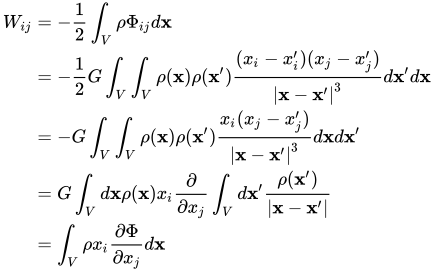
Consider a matter of volume V with density \rho ({\mathbf  {x}}). Thus

{\displaystyle {\begin{aligned}W_{ij}&=-{\frac {1}{2}}\int _{V}\rho \Phi _{ij}d\mathbf {x} \\&=-{\frac {1}{2}}G\int _{V}\int _{V}\rho (\mathbf {x} )\rho (\mathbf {x'} ){\frac {(x_{i}-x_{i}')(x_{j}-x_{j}')}{|\mathbf {x} -\mathbf {x'} |^{3}}}d\mathbf {x'} d\mathbf {x} \\&=-G\int _{V}\int _{V}\rho (\mathbf {x} )\rho (\mathbf {x'} ){\frac {x_{i}(x_{j}-x_{j}')}{|\mathbf {x} -\mathbf {x'} |^{3}}}d\mathbf {x} d\mathbf {x'} \\&=G\int _{V}d\mathbf {x} \rho (\mathbf {x} )x_{i}{\frac {\partial }{\partial x_{j}}}\int _{V}d\mathbf {x'} {\frac {\rho (\mathbf {x'} )}{|\mathbf {x} -\mathbf {x'} |}}\\&=\int _{V}\rho x_{i}{\frac {\partial \Phi }{\partial x_{j}}}d\mathbf {x} \end{aligned}}}

Chandrasekhar tensor in terms of scalar potentialEdit

The scalar potential is defined as

{\displaystyle \chi (\mathbf {x} )=-G\int _{V}\rho (\mathbf {x'} )|\mathbf {x} -\mathbf {x'} |d\mathbf {x'} }

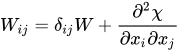
then Chandrasekhar[5] proves that

{\displaystyle W_{ij}=\delta _{ij}W+{\frac {\partial ^{2}\chi }{\partial x_{i}\partial x_{j}}}}

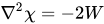
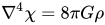
Setting i=j we get {\displaystyle \nabla ^{2}\chi =-2W}, taking Laplacian again, we get {\displaystyle \nabla ^{4}\chi =8\pi G\rho }. 


This article uses material from the Wikipedia article
 Metasyntactic variable, which is released under the 
Creative Commons
Attribution-ShareAlike 3.0 Unported License
.