In astrophysics, the Darwin–Radau equation (named after Rodolphe Radau and Charles Galton Darwin) gives an approximate relation between the moment of inertia factor of a planetary body and its rotational speed and shape. The moment of inertia factor is directly related to the largest principal moment of inertia, C. It is assumed that the rotating body is in hydrostatic equilibrium and is an ellipsoid of revolution. The Darwin–Radau equation states[1]

where M and Re represent the mass and mean equatorial radius of the body. Here λ is the d'Alembert parameter and the Radau parameter η is defined as

where q is the geodynamical constant

and ε is the geometrical flattening
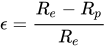
where Rp is the mean polar radius and Re is the mean equatorial radius.
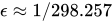
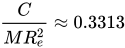
For Earth, and , which yields , a good approximation to the measured value of 0.3307.

| This article uses material from the Wikipedia article Metasyntactic variable, which is released under the Creative Commons Attribution-ShareAlike 3.0 Unported License. |