In astrophysics, Dirichlet's ellipsoidal problem, named after Peter Gustav Lejeune Dirichlet, asks the question that under what conditions there can exist an ellipsoidal configuration at all times of a homogeneous rotating fluid mass in which the motion, in an inertial frame, is a linear function of the coordinates. Dirichlet's basic idea was to reduce Euler equations to a system of ordinary differential equations such that the position of a fluid particle in a homogeneous ellipsoid at any time is a linear and homogeneous function of initial position of the fluid particle, using Lagrangian framework instead of the Eulerian framework.[1][2][3]
HistoryEditIn the winter of 1856-57, Dirichlet found some solutions of Euler equations and he presented those in his lectures on partial differential equations in July 1857 and published the results in the same month.[4] His work was left unfinished at his sudden death in 1859, but his notes were collated and published by Richard Dedekind posthumously in 1860.[5]
Bernhard Riemann said, "In his posthumous paper, edited for publication by Dedekind, Dirichlet has opened up, in a most remarkable way, an entirely new avenue for investigations on the motion of a self-gravitating homogeneous ellipsoid. The further development of his beautiful discovery has a particular interest to the mathematician even apart from its relevance to the forms of heavenly bodies which initially instigated these investigations."
Riemann-Lebovitz formulationEditDirichlet's problem is generalized by Bernhard Riemann in 1860[6] and by Norman R. Lebovitz in modern form in 1965.[7] Let  be the semi-axes of the ellipsoid, which varies with time. Since the ellipsoid is homogeneous, the constancy of mass requires the constancy of the volume of the ellipsoid,

same as the initial volume. Consider an inertial frame 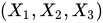 and a rotating frame
  , with
  being the linear transformation such that
  and it is clear that
  is orthogonal, i.e.,
  . We can define an anti-symmetric matrix with this,
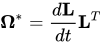
where we can write the dual  of
of  as
as  (and
(and 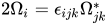 ), where
  is nothing but the time-dependent rotation of the rotating frame with respect to the inertial frame.
Without loss of generality, let us assume that the inertial frame and the moving frame coincide initially, i.e., 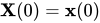 . By definition, Dirichlet's problem is looking for a solution which is a linear function of initial condition . Let us assume the following form,
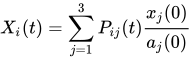 .
.
and we define a diagonal matrix  with diagonal elements being the semi-axes of the ellipsoid, then above equation can be written in matrix form as
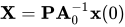
where  . It can shown then that the matrix
  transforms the vector
  linearly to the same vector at any later time
  , i.e.,
  . From the definition of
  , we can realize the vector represents a unit normal on the surface of the ellipsoid (true only at the boundary) since a fluid element on the surface moves with the surface. Therefore, we see that
  transforms one unit vector on the boundary to another unit vector on the boundary, in other words, it is orthogonal, i.e.,
  . In a similar manner as before, we can define another anti-symmetric matrix as
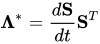 ,
,
where its dual is defined as  (and
(and 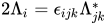 ). The problem is one of uniform vorticity
  with components given by
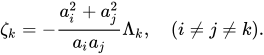
The pressure can take only quadratic form, can be seen from the momentum equation (and using the vanishing condition at the surface) given by
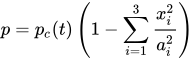
where  is the central pressure, so that
  . Finally, the tensor momentum equation reduce to

where  is the Gravitational constant and
  is diagonal matrix, whose diagonal elements are given by
 .
.
The tensor momentum equation and the conservation of mass equation, i.e.,  provides us with ten equations for the ten unknowns,
  .
.
Dedekind's theoremEditIt states that if a motion determined by  is admissible under the conditions of Dirichlet's problem, then the motion determined by the transpose
  of
of  is also admissible. In other words, the theorem can be stated as for any state of motions that preserves a ellipsoidal figure, there is an adjoint state of motions that preserves the same ellipsoidal figure.
By taking transpose of the tensor momentum equation, one sees that the role of  and are interchanged. If there is solution for
  , then for the same , there exists another solution with the role of and interchanged. But interchanging and is equivalent to replacing by . The following relations confirms the previous statement.

where, further
 .
.
The typical configuration of this theorem is the Jacobi ellipsoid and its adjoint is called as Dedekind ellipsoid, in other words, both ellipsoid have same shape, but their internal fluid motions are different.