The Hubble–Reynolds law models the surface brightness of elliptical galaxies as
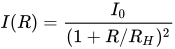
Where is the surface brightness at radius , is the central brightness, and is the radius at which the surface brightness is diminished by a factor of 1/4. It is asymptotically similar to the De Vaucouleurs' law which is a special case of the Sersic profile for elliptical galaxies.[1]


The law is named for the astronomers Edwin Hubble and John Henry Reynolds. It was first formulated by Reynolds in 1913[2] from his observations of galaxies (then still known as nebulae). It was later re-derived by Hubble in 1930[3] specifically in observations of elliptical galaxies.
| This article uses material from the Wikipedia article Metasyntactic variable, which is released under the Creative Commons Attribution-ShareAlike 3.0 Unported License. |