The innermost stable circular orbit (often called the ISCO) is the smallest marginally stable circular orbit in which a test particle can stably orbit a massive object in general relativity.[1] The location of the ISCO, the ISCO-radius (), depends on the angular momentum (spin) of the central object.
The ISCO plays an important role in black hole accretion disks since it marks the inner edge of the disk.
Non-rotating black holes
For a non-spinning massive object, where the gravitational field can be expressed with the Schwarzschild metric, the ISCO is located at
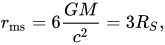
where 


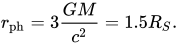
Circular orbits are still possible between the ISCO and the so called marginally bound orbit, but they are unstable, which has a radius of

For a massless test particle like a photon, the only possible but unstable circular orbit is exactly at the photon sphere.[2] Inside the photon sphere, no circular orbits exist. Its radius is
The lack of stability inside the ISCO is explained by the fact that lowering the orbit does not free enough potential energy for the orbital speed necessary: the acceleration gained is too little. This is usually shown by a graph of the orbital effective potential which is lowest at the ISCO.
Rotating black holes
The case for rotating black holes is somewhat more complicated. The equatorial ISCO in the Kerr metric depends on whether the orbit is prograde (negative sign below) or retrograde (positive sign):

where
![{\displaystyle Z_{1}=1+{\sqrt[{3}]{1-\chi ^{2}}}\left({\sqrt[{3}]{1+\chi }}+{\sqrt[{3}]{1-\chi }}\right)}](https://wikimedia.org/api/rest_v1/media/math/render/svg/ff4677b98366ccb2e103a0ef54f6f6c50b07d3ee)
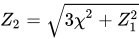
with the rotation parameter 

The marginally bound radius and photon sphere radius in the equatorial plane are respectively
,
.
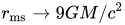
All these three radii drop to 

If the particle is also spinning there is a further split in ISCO radius depending on whether the spin is aligned with or against the black hole rotation.
| This article uses material from the Wikipedia article Metasyntactic variable, which is released under the Creative Commons Attribution-ShareAlike 3.0 Unported License. |