Magnetic helicity is a quantity found in the context of magnetohydrodynamics. It quantifies topological aspects of the magnetic field lines: how much they are linked, twisted, writhed and knotted.[1][2] When the electrical resistivity of a system is zero, its total magnetic helicity is conserved (it is an ideal quadratic invariant[3][4]). When a magnetic field contains magnetic helicity, it tends to form large-scale structures from small-scale ones.[5] This process can be referred as an inverse transfer in Fourier space.
This second property makes magnetic helicity special: three-dimensional turbulent flows tend to “destroy” structure, in the sense that large-scale vortices break-up in smaller and smaller ones (a process called “direct energy cascade”, described by Lewis Fry Richardson and Andrey Nikolaevich Kolmogorov). At the smallest scales, the vortices are dissipated in heat through viscous effects. Through a sort of “inverse cascade of magnetic helicity”, the opposite happens: small helical structures (with a non-zero magnetic helicity) lead to the formation of large-scale magnetic fields. This is for example visible in the heliospheric current sheet [6] – a large magnetic structure in our solar system.
Magnetic helicity is of great relevance in several astrophysical systems, where the resistivity is typically very low, so that magnetic helicity is conserved to a very good approximation. For example: magnetic helicity dynamics are important in solar flares and coronal mass ejections.[7] Magnetic helicity is present in the solar wind.[8] Its conservation is very important in dynamo processes.[9][10][11][12] It also plays a role in fusion research, for example in reversed field pinch experiments.[13]
Mathematical definitionEditThe helicity  of a smooth vector field
  defined on a domain in 3D space is the standard measure of the extent to which the field lines wrap and coil around one another.[14][2] It is defined as the volume integral of the scalar product of and its curl
  :
:
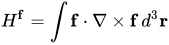 ,
,
where  is the differential volume element for the volume integral, the integration taking place over the whole considered domain.
As to magnetic helicity  , it is the helicity of the magnetic vector potential
  , such that
  is the magnetic field:[9]
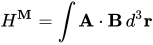 .
.
Magnetic helicity has units of Wb2 (webers squared) in SI units and Mx2 (maxwells squared) in Gaussian Units.[15]
Magnetic helicity should not be confused with the helicity of the magnetic field 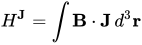 , with
  the current. This quantity is called the "current helicity".[16] Contrary to magnetic helicity, current helicity is not an ideal invariant (it is not conserved even when the electrical resistivity is zero).
Since the magnetic vector potential is not gauge invariant, the magnetic helicity is also not gauge invariant in general. As a consquence, one cannot measure directly the magnetic helicity of a physical system. In certain conditions and under certain assumptions, one can however measure the current helicity of a system and from it, when further conditions are fulfilled and under further assumptions, deduce the magnetic helicity.[17]
Topological interpretationEditThe name "helicity" relies on the fact that the trajectory of a fluid particle in a fluid with velocity  and vorticity
  forms a helix in regions where the kinetic helicity
  . When
  , the helix is right-handed and when
  it is left-handed. This behaviour is very similar for magnetic field lines.
Regions where magnetic helicity is not zero can also contain other sorts of magnetic structures as helical magnetic field lines. Magnetic helicity is indeed a generalization of the topological concept of linking number to the differential quantities required to describe the magnetic field.[6] The linking number describes how much magnetic field lines are interlinked (see [9] for a mathematical proof of it). Through a simple experiment with paper and scissors, one can show that magnetic field lines which turn around each other can be considered as being interlinked (figure 5 in [9]). Thus, the presence of magnetic helicity can be interpreted as helical magnetic field lines, interlinked magnetic structures, but also magnetic field lines turning around each other.

Example of helical structures in the DNA. It looks similar for helical magnetic field lines. Topologically speaking: units of writhe and units of twist can be interchanged.
Magnetic field lines turning around each other can take several shapes. Let's consider for example a set of turning magnetic field lines in a close neighborhood, which forms a so-called "magnetic flux tube" (see figure for an illustration).
"Twist" means that the flux tube rotates around its own axis (figures with Twist= ). Topologically speaking, units of twist and of writhe (which means, the rotation of the flux tube axis itself — figures with Writhe=) can be transformed into each other. One can also show that knots are also equivalent to units of twist and/or writhe.[2]
As with many quantities in electromagnetism, magnetic helicity (which describes magnetic field lines) is closely related to fluid mechanical helicity (which describes fluid flow lines) and their dynamics are interlinked.[5][18]
Ideal quadratic invarianceEditIn the late 1950s, Lodewijk Woltjer and Walter M. Elsässer discovered independently the ideal invariance of magnetic helicity,[4][3] that is, its conservation in case of a zero resistivity. Woltjer's proof, valid for a closed system, is repeated in the following:
In ideal MHD, the magnetic field and magnetic vector potential time evolution are governed by:


where the second equation is obtained by "uncurling" the first one and  is a scalar potential given by the gauge condition (see the paragraph about gauge consideration). Choosing the gauge so that the scalar potential vanishes (=0), the magnetic helicity time evolution is given by:
 .
.
The first integral is zero since  is orthogonal to the cross-product
  . The second integral can be integrated by parts, giving:

The first integral is done over the whole volume and is zero because  as written above. The second integral corresponds to the surface integral over
  , the boundaries of the closed system. It is zero because motions inside the closed system cannot affect the vector potential outside, so that at the boundary surface
  , since the magnetic vector potential is a continuous function.
In all situations where magnetic helicity is gauge invariant (see paragraph below), magnetic helicity is hence ideally conserved without the need of the specific gauge choice  .
.
Magnetic helicity remains conserved in a good approximation even with a small but finite resistivity, in which case magnetic reconnection dissipates energy.[6][9]
Inverse transfer propertyEditSmall-scale helical structures tend to form larger and larger magnetic structures. This can be called an inverse transfer in Fourier space, as opposed to the (direct) energy cascade in threedimensional turbulent hydrodynamical flows. The possibility of such an inverse transfer has first been proposed by Uriel Frisch and collaborators[5] and has been verified through many numerical experiments.[19][20][21][22][23][24] As a consequence, the presence of magnetic helicity is a possibility to explain the existence and sustainment of large-scale magnetic structures in the Universe.
An argument for this inverse transfer taken from[5] is repeated here, which is based on the so-called "realizability condition" on the magnetic helicity Fourier spectrum 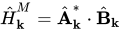 (where
  is the Fourier coefficient at the wavevector
  of the magnetic field , and similarly for
  , the star denoting the complex conjugate. The "realizability condition" corresponds to an application of Cauchy-Schwarz inequality, which yields:
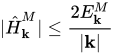 ,
,
with 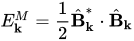 the magnetic energy spectrum. To obtain this inequality, the fact that
 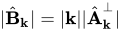 (with
(with  the solenoidal part of the Fourier transformed magnetic vector potential, orthogonal to the wavevector in Fourier space) has been used, since
 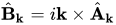 . The factor 2 is not present in the paper[5] since the magnetic helicity is defined there alternatively as
 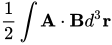 .
.
One can then imagine an initial situation with no velocity field and a magnetic field only present at two wavevectors  and
and  . We assume a fully helical magnetic field, which means that it saturates the realizability condition:
 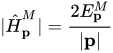 and
and 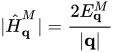 . Assuming that all the energy and magnetic helicity transfers are done to another wavevector
  , the conservation of magnetic helicity on the one hand and of the total energy
  (the sum of (m)agnetic and (k)inetic energy) on the other hand gives:


The second equality for the energy comes from the fact that we consider an initial state with no kinetic energy. Then we have necessarily  . Indeed, if we would have
  , then:

which would break the realizability condition. This means that . In particular, for  , the magnetic helicity is transferred to a smaller wavevector, which means to larger scales.
Gauge considerationsEditMagnetic helicity is a gauge-dependent quantity, because  can be redefined by adding a gradient to it (gauge choosing). However, for perfectly conducting boundaries or periodic systems without a net magnetic flux, the magnetic helicity contained in the whole domain is gauge invariant,[16] that is, independent of the gauge choice. A gauge-invariant relative helicity has been defined for volumes with non-zero magnetic flux on their boundary surfaces.