In particle physics and physical cosmology, Planck units are a set of units of measurement defined exclusively in terms of four universal physical constants, in such a manner that these physical constants take on the numerical value of 1 when expressed in terms of these units.
Originally proposed in 1899 by German physicist Max Planck, these units are a system of natural units because the origin of their definition comes only from properties of nature and not from any human construct. Planck units are only one of several systems of natural units, but Planck units are not based on properties of any prototype object or particle (the choice of which is inherently arbitrary), but rather on only the properties of free space. They are relevant in research on unified theories such as quantum gravity.
The term Planck scale refers to quantities of space, time, energy and other units that are similar in magnitude to corresponding Planck units. This region may be characterized by energies of around 1019 GeV, time intervals of around 10−43 s and lengths of around 10−35 m (approximately respectively the energy-equivalent of the Planck mass, the Planck time and the Planck length). At the Planck scale, the predictions of the Standard Model, quantum field theory and general relativity are not expected to apply, and quantum effects of gravity are expected to dominate. The best known example is represented by the conditions in the first 10−43 seconds of our universe after the Big Bang, approximately 13.8 billion years ago.
The four universal constants that, by definition, have a numeric value 1 when expressed in these units are:
- the speed of light in a vacuum, c,
- the gravitational constant, G,
- the reduced Planck constant, ħ,
- the Boltzmann constant, kB.
Planck units do not incorporate an electromagnetic dimension. Some authors choose to extend the system to electromagnetism by, for example, defining the electric constant ε0 as having the numeric value 1 or 1 / 4π in this system. Similarly, authors choose to use variants of the system that give other numeric values to one or more of the four constants above.
Introduction
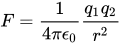
Any system of measurement may be assigned a mutually independent set of base quantities and associated base units, from which all other quantities and units may be derived. In the International System of Units, for example, the SI base quantities include length with the associated unit of the metre. In the system of Planck units, a similar set of base quantities and associated units may be selected, in terms of which other quantities and coherent units may be expressed. The Planck unit of length has become known as the Planck length, and the Planck unit of time is known as the Planck time, but this nomenclature has not been established as extending to all quantities. All Planck units are derived from the dimensional universal physical constants that define the system, and in a convention in which these units are omitted (i.e. treated as having the dimensionless value 1), these constants are then eliminated from equations of physics in which they appear. For example, Newton's law of universal gravitation,

can be expressed as:
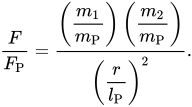
Both equations are dimensionally consistent and equally valid in any system of units, but the second equation, with G absent, is relating only dimensionless quantities since any ratio of two like-dimensioned quantities is a dimensionless quantity. If, by a shorthand convention, it is understood that all physical quantities are expressed in terms of Planck units, the ratios above may be expressed simply with the symbols of physical quantity, without being scaled explicitly by their corresponding unit:
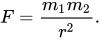
This last equation (without G) is valid only if F, m1, m2, and r are the dimensionless numerical values of these quantities measured in terms of Planck units. This is why Planck units or any other use of natural units should be employed with care. Referring to G = c = 1, Paul S. Wesson wrote that, "Mathematically it is an acceptable trick which saves labour. Physically it represents a loss of information and can lead to confusion."[1]
History and definition
The concept of natural units was introduced in 1881, when George Johnstone Stoney, noting that electric charge is quantized, derived units of length, time, and mass, now named Stoney units in his honor, by normalizing G, c, and the electron charge, e, to 1. In 1899, one year before the advent of quantum theory, Max Planck introduced what became later known as the Planck constant.[2][3] At the end of the paper, he proposed the base units later named in his honor. The Planck units are based on the quantum of action, now usually known as the Planck constant, which appeared in the Wien approximation for blackbody radiation. Planck underlined the universality of the new unit system, writing:
Planck considered only the units based on the universal constants 


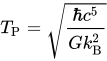
Unlike the case with the International System of Units, there is no official entity that establishes a definition of a Planck-unit system. Frank Wilczek and Barton Zwiebach both define the base Planck units to be those of mass, length and time, regarding an additional unit for temperature to be redundant.[8][9] Other tabulations add, in addition to a unit for temperature, a unit for electric charge,[10] sometimes also replacing mass with energy when doing so.[11] This charge unit is given by

The Planck charge, as well as other electromagnetic units that can be defined like resistance and magnetic flux, are more difficult to interpret than Planck's original units and are used less frequently.[12] (Setting 
The values of c, h, e and kB in SI units are exact due to the definition of the second, metre, kilogram and kelvin in terms of these constants, and contribute no uncertainty to the values of the Planck units expressed in terms of SI units. The vacuum permittivity ε0 has a relative uncertainty of 1.5×10⁻¹⁰.[14] The numerical value of G has been determined experimentally to a relative uncertainty of 2.2×10⁻⁵.[15] Hence, the uncertainty in these values of the Planck units derives almost entirely from uncertainty in the value of G. Moreover, because the SI values of Planck units that do not depend upon G ε0 are exact, one Planck length divided by one Planck time is equal exactly to 1 lP1 tP = c = 299792458 m/s.
Derived units
In any system of measurement, units for many physical quantities can be derived from base units. Table 2 offers a sample of derived Planck units, some of which in fact are seldom used. As with the base units, their use is mostly confined to theoretical physics because most of them are too large or too small for empirical or practical use and there are large uncertainties in their values.

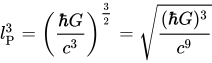
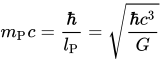
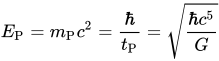
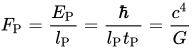
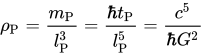
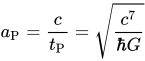
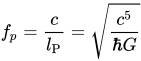
Some Planck units, such as of time and length, are many orders of magnitude too large or too small to be of practical use, so that Planck units as a system are typically only relevant to theoretical physics. In some cases, a Planck unit may suggest a limit to a range of a physical quantity where present-day theories of physics apply[citation needed]. For example, our understanding of the Big Bang begins with the Planck epoch, when the universe was one Planck time old and one Planck length in diameter.[citation needed] Describing the universe when it was less than one Planck time old requires a theory of quantum gravity that would incorporate quantum effects into general relativity. Such a theory does not yet exist.
Several quantities are not "extreme" in magnitude, such as the Planck mass, which is about 22 micrograms: very large in comparison with subatomic particles, but well within the mass range of living things. Similarly, the related units of energy and of momentum are in the range of some everyday phenomena.
Significance
Planck units have little anthropocentric arbitrariness, but do still involve some arbitrary choices in terms of the defining constants. Unlike the metre and second, which exist as base units in the SI system for historical reasons, the Planck length and Planck time are conceptually linked at a fundamental physical level. Consequently, natural units help physicists to reframe questions. Frank Wilczek puts it succinctly:
While it is true that the electrostatic repulsive force between two protons (alone in free space) greatly exceeds the gravitational attractive force between the same two protons, this is not about the relative strengths of the two fundamental forces. From the point of view of Planck units, this is comparing apples with oranges, because mass and electric charge are incommensurable quantities. Rather, the disparity of magnitude of force is a manifestation of the fact that the charge on the protons is approximately the unit charge but the mass of the protons is far less than the unit mass.
Planck scale
In particle physics and physical cosmology, the Planck scale is an energy scale around 1.22 × 10¹⁹ GeV (the Planck energy, corresponding to the mass–energy equivalence of the Planck mass, 2.17645 × 10⁻⁸ kg) at which quantum effects of gravity become strong. At this scale, present descriptions and theories of sub-atomic particle interactions in terms of quantum field theory break down and become inadequate, due to the impact of the apparent non-renormalizability of gravity within current theories.
Relationship to gravity
At the Planck length scale, the strength of gravity is expected to become comparable with the other forces, and it is theorized that all the fundamental forces are unified at that scale, but the exact mechanism of this unification remains unknown. The Planck scale is therefore the point where the effects of quantum gravity can no longer be ignored in other fundamental interactions, and where current calculations and approaches begin to break down, and a means to take account of its impact is required.[17][18]
While physicists have a fairly good understanding of the other fundamental interactions of forces on the quantum level, gravity is problematic, and cannot be integrated with quantum mechanics at very high energies using the usual framework of quantum field theory. At lesser energy levels it is usually ignored, while for energies approaching or exceeding the Planck scale, a new theory of quantum gravity is required. Other approaches to this problem include string theory and M-theory, loop quantum gravity, noncommutative geometry, scale relativity, causal set theory and P-adic quantum mechanics.[19]
In cosmology
In Big Bang cosmology, the Planck epoch or Planck era is the earliest stage of the Big Bang, before the time passed was equal to the Planck time, tP, or approximately 10−43 seconds.[20] There is no currently available physical theory to describe such short times, and it is not clear in what sense the concept of time is meaningful for values smaller than the Planck time. It is generally assumed that quantum effects of gravity dominate physical interactions at this time scale. At this scale, the unified force of the Standard Model is assumed to be unified with gravitation. Immeasurably hot and dense, the state of the Planck epoch was succeeded by the grand unification epoch, where gravitation is separated from the unified force of the Standard Model, in turn followed by the inflationary epoch, which ended after about 10−32 seconds (or about 1010 tP).[21]
The observable universe today expressed in Planck units:[22][23]
After the measurement of the cosmological constant in 1998, estimated at 10−122 in Planck units, it was noted that this is suggestively close to the reciprocal of the age of the universe squared. Barrow and Shaw proposed a modified theory in which Λ is a field evolving in such a way that its value remains Λ ~ T−2 throughout the history of the universe.[24]
Analysis of the units
Planck time and length
The Planck length, denoted ℓP, is a unit of length defined as:

It is equal to 1.616255(18)×10−35 m[4] where the two digits enclosed by parentheses are the estimated standard error associated with the reported numerical value.
A Planck time unit is the time required for light to travel a distance of 1 Planck length in a vacuum, which is a time interval of approximately 5.39 × 10−44 s.[25] All scientific experiments and human experiences occur over time scales that are many orders of magnitude longer than the Planck time,[26] making any events happening at the Planck scale undetectable with current scientific technology. As of October 2020, the smallest time interval uncertainty in direct measurements was on the order of 247 zeptoseconds (2.47 × 10⁻¹⁹ seconds).[27]
While there is currently no known way to measure time intervals on the scale of the Planck time, researchers in 2020 proposed a theoretical apparatus and experiment that, if ever realized, could be capable of being influenced by effects of time as short as 10−33 seconds, thus establishing an upper detectable limit for the quantization of a time that is roughly 20 billion times longer than the Planck time.[28][29]
Planck energy
Most Planck units are extremely small, as in the case of Planck length or Planck time, or extremely large, as in the case of Planck temperature or Planck acceleration. For comparison, the Planck energy is approximately equal to the energy stored in an automobile gas tank (57.2 L of gasoline at 34.2 MJ/L of chemical energy). The ultra-high-energy cosmic ray observed in 1991 had a measured energy of about 50 J, equivalent to about 2.5×10⁻⁸ EP.[30] Theoretically, the highest energy photon carries about 1 EP of energy (see Ultra-high-energy gamma ray), and any further increase of energy (trans-Planckian photon) will make it indistinguishable from a Planck particle carrying the same momentum.
Planck force
The Planck force is the derived unit of force resulting from the definition of the base Planck units for time, length, and mass. It is equal to the natural unit of momentum divided by the natural unit of time.

The gravitational attractive force of two bodies of 1 Planck mass each, set apart by 1 Planck length is 1 Planck force; equivalently, the electrostatic attractive/repulsive force of two Planck charges set apart by 1 Planck length is 1 Planck force.
Various authors have argued that the Planck force is on the order of the maximum force that can be observed in nature.[31][32] However, the validity of these conjectures has been disputed.[33]
Planck momentum

The Planck momentum is equal to the Planck mass multiplied by the speed of light. Unlike most of the other Planck units, Planck momentum occurs on a human scale. By comparison, running with a five-pound object (108 × Planck mass) at an average running speed (10−8 × speed of light in a vacuum) would give the object Planck momentum. A 70 kg human moving at an average walking speed of 1.4 m/s (5.0 km/h; 3.1 mph) would have a momentum of about 15 

Planck density
The Planck density is a very large unit, equivalent to about 1093 grams squeezed into the space of a single cubic centimetre. The Planck density is thought to be the upper limit of density.[citation needed]
Planck temperature
The Planck temperature of 1 (unity), equal to 1.416784(16)×1032 K[7], is considered a fundamental limit of temperature.[34] An object with the temperature of 1.42×1032 kelvin (TP) would emit a black body radiation with a peak wavelength of 1.616×10⁻³⁵ m (Planck length), where each photon and each individual collision would have the energy to create a Planck particle. There are no known physical models able to describe temperatures greater than or equal to TP.
List of physical equations
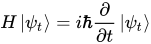
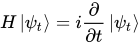
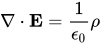
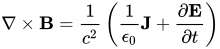
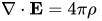
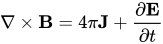
Physical quantities that have different dimensions (such as time and length) cannot be equated even if they are numerically equal (1 second is not the same as 1 metre). In theoretical physics, however, this scruple can be set aside, by a process called nondimensionalization. Table 3 shows how the use of Planck units simplifies many fundamental equations of physics, because this gives each of the five fundamental constants, and products of them, a simple numeric value of 1. In the SI form, the units should be accounted for. In the nondimensionalized form, the units, which are now Planck units, need not be written if their use is understood.

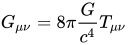




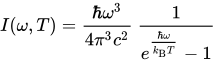













Alternative choices of normalization
As already stated above, Planck units are derived by "normalizing" the numerical values of certain fundamental constants to 1. These normalizations are neither the only ones possible nor necessarily the best. Moreover, the choice of what factors to normalize, among the factors appearing in the fundamental equations of physics, is not evident, and the values of the Planck units are sensitive to this choice.
The factor 4π is ubiquitous in theoretical physics because the surface area of a sphere of radius r is 4πr2 in contexts having spherical symmetry in three dimensions. This, along with the concept of flux, are the basis for the inverse-square law, Gauss's law, and the divergence operator applied to flux density. For example, gravitational and electrostatic fields produced by point charges have spherical symmetry (Barrow 2002: 214–15). The 4πr2 appearing in the denominator of Coulomb's law in rationalized form, for example, follows from the flux of an electrostatic field being distributed uniformly on the surface of a sphere. Likewise for Newton's law of universal gravitation. (If space had more than three spatial dimensions, the factor 4π would be changed according to the geometry of the sphere in higher dimensions.)
Hence a substantial body of physical theory developed since Planck (1899) suggests normalizing not G but either 4πG (or 8πG or 16πG) to 1. Doing so would introduce a factor of 14π (or 18π or 116π) into the nondimensionalized form of the law of universal gravitation, consistent with the modern rationalized formulation of Coulomb's law in terms of the vacuum permittivity. In fact, alternative normalizations frequently preserve the factor of 14π in the nondimensionalized form of Coulomb's law as well, so that the nondimensionalized Maxwell's equations for electromagnetism and gravitoelectromagnetism both take the same form as those for electromagnetism in SI, which do not have any factors of 4π. When this is applied to electromagnetic constants, ε0, this unit system is called "rationalized". When applied additionally to gravitation and Planck units, these are called rationalized Planck units[36] and are seen in high-energy physics.[37]
The rationalized Planck units are defined so that 
There are several possible alternative normalizations.
Gravitational constant
In 1899, Newton's law of universal gravitation was still seen as exact, rather than as a convenient approximation holding for "small" velocities and masses (the approximate nature of Newton's law was shown following the development of general relativity in 1915). Hence Planck normalized to 1 the gravitational constant G in Newton's law. In theories emerging after 1899, G nearly always appears in formulae multiplied by 4π or a small integer multiple thereof. Hence, a choice to be made when designing a system of natural units is which, if any, instances of 4π appearing in the equations of physics are to be eliminated via the normalization.
- Normalizing 4πG to 1 (and therefore setting G = 14π):
- Gauss's law for gravity becomes Φg = −M (rather than Φg = −4πM in Planck units).
- Eliminates 4πG from the Poisson equation.
- Eliminates 4πG in the gravitoelectromagnetic (GEM) equations, which hold in weak gravitational fields or locally flat spacetime. These equations have the same form as Maxwell's equations (and the Lorentz force equation) of electromagnetism, with mass density replacing charge density, and with 14πG replacing ε0.
- Normalizes the characteristic impedance Zg of gravitational radiation in free space to 1 (normally expressed as 4πGc).[note 1]
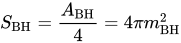
- Eliminates 4πG from the Bekenstein–Hawking formula (for the entropy of a black hole in terms of its mass mBH and the area of its event horizon ABH) which is simplified to SBH = πABH = (mBH)2.
- Setting 8πG = 1 (and therefore setting G = 18π). This would eliminate 8πG from the Einstein field equations, Einstein–Hilbert action, and the Friedmann equations, for gravitation. Planck units modified so that 8πG = 1 are known as reduced Planck units, because the Planck mass is divided by √8π. Also, the Bekenstein–Hawking formula for the entropy of a black hole simplifies to SBH = (mBH)2/2 = 2πABH.
- Setting 16πG = 1 (and therefore setting G = 116π). This would eliminate the constant c416πG from the Einstein–Hilbert action. The form of the Einstein field equations with cosmological constant Λ becomes Rμν − 12Rgμν + Λgμν = 12Tμν.
Planck units and the invariant scaling of nature
Some theorists (such as Dirac and Milne) have proposed cosmologies that conjecture that physical "constants" might actually change over time (e.g. a variable speed of light or Dirac varying-G theory). Such cosmologies have not gained mainstream acceptance and yet there is still considerable scientific interest in the possibility that physical "constants" might change, although such propositions introduce difficult questions. Perhaps the first question to address is: How would such a change make a noticeable operational difference in physical measurement or, more fundamentally, our perception of reality? If some particular physical constant had changed, how would we notice it, or how would physical reality be different? Which changed constants result in a meaningful and measurable difference in physical reality? If a physical constant that is not dimensionless, such as the speed of light, did in fact change, would we be able to notice it or measure it unambiguously? – a question examined by Michael Duff in his paper "Comment on time-variation of fundamental constants".[38][39]
George Gamow argued in his book Mr Tompkins in Wonderland that a sufficient change in a dimensionful physical constant, such as the speed of light in a vacuum, would result in obvious perceptible changes. But this idea is challenged:
Referring to Duff's "Comment on time-variation of fundamental constants"[38] and Duff, Okun, and Veneziano's paper "Trialogue on the number of fundamental constants",[40] particularly the section entitled "The operationally indistinguishable world of Mr. Tompkins", if all physical quantities (masses and other properties of particles) were expressed in terms of Planck units, those quantities would be dimensionless numbers (mass divided by the Planck mass, length divided by the Planck length, etc.) and the only quantities that we ultimately measure in physical experiments or in our perception of reality are dimensionless numbers. When one commonly measures a length with a ruler or tape-measure, that person is actually counting tick marks on a given standard or is measuring the length relative to that given standard, which is a dimensionless value. It is no different for physical experiments, as all physical quantities are measured relative to some other like-dimensioned quantity.
We can notice a difference if some dimensionless physical quantity such as fine-structure constant, α, changes or the proton-to-electron mass ratio, mpme, changes (atomic structures would change) but if all dimensionless physical quantities remained unchanged (this includes all possible ratios of identically dimensioned physical quantity), we cannot tell if a dimensionful quantity, such as the speed of light, c, has changed. And, indeed, the Tompkins concept becomes meaningless in our perception of reality if a dimensional quantity such as c has changed, even drastically.
If the speed of light c, were somehow suddenly cut in half and changed to 12c (but with the axiom that all dimensionless physical quantities remain the same), then the Planck length would increase by a factor of 2√2 from the point of view of some unaffected observer on the outside. Measured by "mortal" observers in terms of Planck units, the new speed of light would remain as 1 new Planck length per 1 new Planck time – which is no different from the old measurement. But, since by axiom, the size of atoms (approximately the Bohr radius) are related to the Planck length by an unchanging dimensionless constant of proportionality:
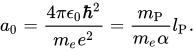
Then atoms would be bigger (in one dimension) by 2√2, each of us would be taller by 2√2, and so would our metre sticks be taller (and wider and thicker) by a factor of 2√2. Our perception of distance and lengths relative to the Planck length is, by axiom, an unchanging dimensionless constant.
Our clocks would tick slower by a factor of 4√2 (from the point of view of this unaffected observer on the outside) because the Planck time has increased by 4√2 but we would not know the difference (our perception of durations of time relative to the Planck time is, by axiom, an unchanging dimensionless constant). This hypothetical unaffected observer on the outside might observe that light now propagates at half the speed that it previously did (as well as all other observed velocities) but it would still travel 299792458 of our new metres in the time elapsed by one of our new seconds (12c × 4√2 ÷ 2√2 continues to equal 299792458 m/s). We would not notice any difference.
This contradicts what George Gamow writes in his book Mr. Tompkins; there, Gamow suggests that if a dimension-dependent universal constant such as c changed significantly, we would easily notice the difference. The disagreement is better thought of as the ambiguity in the phrase "changing a physical constant"; what would happen depends on whether (1) all other dimensionless constants were kept the same, or whether (2) all other dimension-dependent constants are kept the same. The second choice is a somewhat confusing possibility, since most of our units of measurement are defined in relation to the outcomes of physical experiments, and the experimental results depend on the constants. Gamow does not address this subtlety; the thought experiments he conducts in his popular works assume the second choice for "changing a physical constant". And Duff or Barrow would point out that ascribing a change in measurable reality, i.e. α, to a specific dimensional component quantity, such as c, is unjustified. The very same operational difference in measurement or perceived reality could just as well be caused by a change in h or e if α is changed and no other dimensionless constants are changed. It is only the dimensionless physical constants that ultimately matter in the definition of worlds.[38][41]
This unvarying aspect of the Planck-relative scale, or that of any other system of natural units, leads many theorists to conclude that a hypothetical change in dimensionful physical constants can only be manifest as a change in dimensionless physical constants. One such dimensionless physical constant is the fine-structure constant. There are some experimental physicists who assert they have in fact measured a change in the fine structure constant[42] and this has intensified the debate about the measurement of physical constants. According to some theorists[43] there are some very special circumstances in which changes in the fine-structure constant can be measured as a change in dimensionful physical constants. Others however reject the possibility of measuring a change in dimensionful physical constants under any circumstance.[38] The difficulty or even the impossibility of measuring changes in dimensionful physical constants has led some theorists to debate with each other whether or not a dimensionful physical constant has any practical significance at all and that in turn leads to questions about which dimensionful physical constants are meaningful.
| This article uses material from the Wikipedia article Metasyntactic variable, which is released under the Creative Commons Attribution-ShareAlike 3.0 Unported License. |