Plasma parameters define various characteristics of a plasma, an electrically conductive collection of charged particles that responds collectively to electromagnetic forces. Plasma typically takes the form of neutral gas-like clouds or charged ion beams, but may also include dust and grains.[1] The behaviour of such particle systems can be studied statistically.[2]

Fundamental plasma parameters
All quantities are in Gaussian (cgs) units except energy and temperature expressed in eV and ion mass expressed in units of the proton mass 


Frequencies
- electron gyrofrequency, the angular frequency of the circular motion of an electron in the plane perpendicular to the magnetic field:
- ion gyrofrequency, the angular frequency of the circular motion of an ion in the plane perpendicular to the magnetic field:
- electron plasma frequency, the frequency with which electrons oscillate (plasma oscillation):
- ion plasma frequency:
- electron trapping rate:
- ion trapping rate:
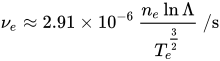
- electron collision rate in completely ionized plasmas:
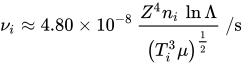
- ion collision rate in completely ionized plasmas:






Lengths
- electron thermal de Broglie wavelength, approximate average de Broglie wavelength of electrons in a plasma:
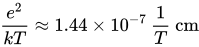
- classical distance of closest approach, the closest that two particles with the elementary charge come to each other if they approach head-on and each has a velocity typical of the temperature, ignoring quantum-mechanical effects:
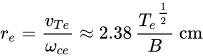
- electron gyroradius, the radius of the circular motion of an electron in the plane perpendicular to the magnetic field:
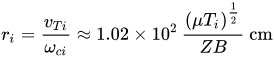
- ion gyroradius, the radius of the circular motion of an ion in the plane perpendicular to the magnetic field:
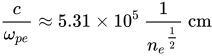
- plasma skin depth (also called the electron inertial length), the depth in a plasma to which electromagnetic radiation can penetrate:
- Debye length, the scale over which electric fields are screened out by a redistribution of the electrons:
- ion inertial length, the scale at which ions decouple from electrons and the magnetic field becomes frozen into the electron fluid rather than the bulk plasma:
- mean free path, the average distance between two subsequent collisions of the electron (ion) with plasma components:
,
is an average velocity of the electron (ion) and
is the electron or ion collision rate.



Velocities
- electron thermal velocity, typical velocity of an electron in a Maxwell–Boltzmann distribution:
- ion thermal velocity, typical velocity of an ion in a Maxwell–Boltzmann distribution:
- ion speed of sound, the speed of the longitudinal waves resulting from the mass of the ions and the pressure of the electrons:
,
is the adiabatic index
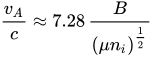
- Alfvén velocity, the speed of the waves resulting from the mass of the ions and the restoring force of the magnetic field:
in cgs units,
in SI units.


Dimensionless

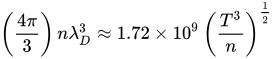
- number of particles in a Debye sphere
- Alfvén speed to speed of light ratio
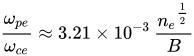
- electron plasma frequency to gyrofrequency ratio
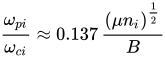
- ion plasma frequency to gyrofrequency ratio
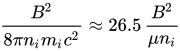
- thermal pressure to magnetic pressure ratio, or beta, β
- magnetic field energy to ion rest energy ratio

Collisionality
In the study of tokamaks, collisionality is a dimensionless parameter which expresses the ratio of the electron-ion collision frequency to the banana orbit frequency.
The plasma collisionality 
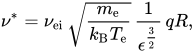
where 


Electron temperature
Temperature is a statistical quantity whose formal definition is
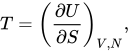
or the change in internal energy with respect to entropy, holding volume and particle number constant. A practical definition comes from the fact that the atoms, molecules, or whatever particles in a system have an average kinetic energy. The average means to average over the kinetic energy of all the particles in a system.
If the velocities of a group of electrons, e.g., in a plasma, follow a Maxwell–Boltzmann distribution, then the electron temperature is defined as the temperature of that distribution. For other distributions, not assumed to be in equilibrium or have a temperature, two-thirds of the average energy is often referred to as the temperature, since for a Maxwell–Boltzmann distribution with three degrees of freedom, 
The SI unit of temperature is the kelvin (K), but using the above relation the electron temperature is often expressed in terms of the energy unit electronvolt (eV). Each kelvin (1 K) corresponds to 8.617 333 262...×10−5 eV; this factor is the ratio of the Boltzmann constant to the elementary charge.[5] Each eV is equivalent to 11,605 kelvins, which can be calculated by the relation 
The electron temperature of a plasma can be several orders of magnitude higher than the temperature of the neutral species or of the ions. This is a result of two facts. Firstly, many plasma sources heat the electrons more strongly than the ions. Secondly, atoms and ions are much heavier than electrons, and energy transfer in a two-body collision is much more efficient if the masses are similar. Therefore, equilibration of the temperature happens very slowly, and is not achieved during the time range of the observation.
| This article uses material from the Wikipedia article Metasyntactic variable, which is released under the Creative Commons Attribution-ShareAlike 3.0 Unported License. |