The Sérsic profile (or Sérsic model or Sérsic's law) is a mathematical function that describes how the intensity of a galaxy varies with distance from its center. It is a generalization of de Vaucouleurs' law. José Luis Sérsic first published his law in 1963.[1]

Definition
The Sérsic profile has the form

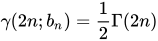
where 


Today, it is more common to write this function in terms of the half-light radius, Re, and the intensity at that radius, Ie, such that
![{\displaystyle I(R)=I_{e}\exp \left\{-b_{n}\left[\left({\frac {R}{R_{e}}}\right)^{1/n}-1\right]\right\},}](https://wikimedia.org/api/rest_v1/media/math/render/svg/364fa183231421cdf536519b4f8f1ea1b2f294b4)
where 


Applications

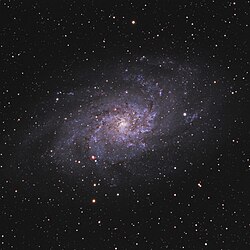
Most galaxies are fit by Sérsic profiles with indices in the range 1/2 < n < 10. The best-fit value of n correlates with galaxy size and luminosity, such that bigger and brighter galaxies tend to be fit with larger n. [4][5] Setting n = 4 gives the de Vaucouleurs profile:
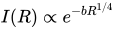
which is a rough approximation of ordinary elliptical galaxies. Setting n = 1 gives the exponential profile:

which is a good approximation of spiral galaxy disks and a rough approximation of dwarf elliptical galaxies. The correlation of Sérsic index (i.e. galaxy concentration[6]) with galaxy morphology is sometimes used in automated schemes to determine the Hubble type of distant galaxies.[7] Sérsic indices have also been shown to correlate with the mass of the supermassive black hole at the centers of the galaxies. [8]
Sérsic profiles can also be used to describe dark matter halos, where the Sérsic index correlates with halo mass.[9][10]
Generalizations of the Sérsic profile
The brightest elliptical galaxies often have low-density cores that are not well described by Sérsic's law. The core-Sérsic family of models was introduced [11][12][13] to describe such galaxies. Core-Sérsic models have an additional set of parameters that describe the core.
Dwarf elliptical galaxies and bulges often have point-like nuclei that are also not well described by Sérsic's law. These galaxies are often fit by a Sérsic model with an added central component representing the nucleus. [14][15]
The Einasto profile is mathematically identical to the Sérsic profile, except that 


| This article uses material from the Wikipedia article Metasyntactic variable, which is released under the Creative Commons Attribution-ShareAlike 3.0 Unported License. |